





Programme on Union Budget 2026


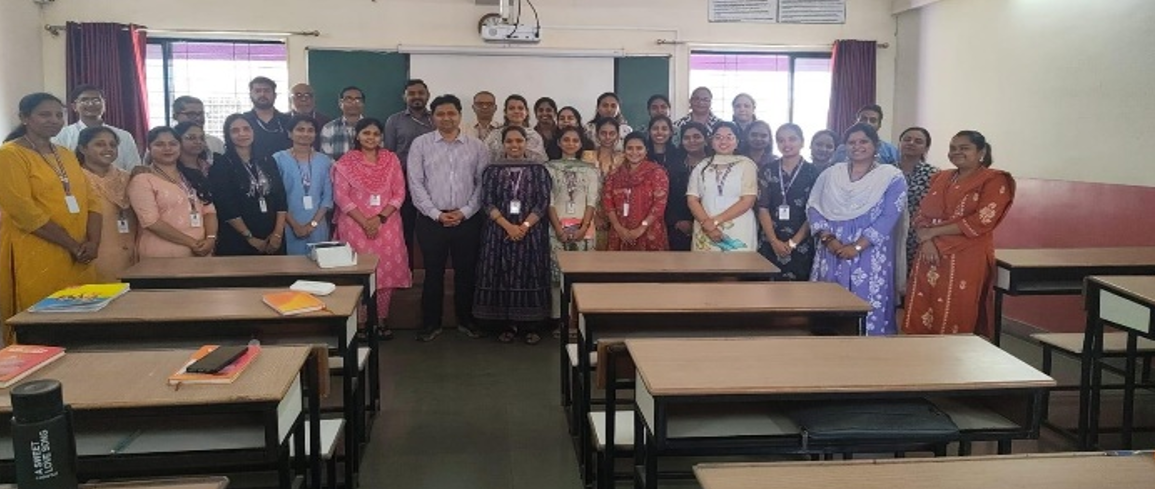
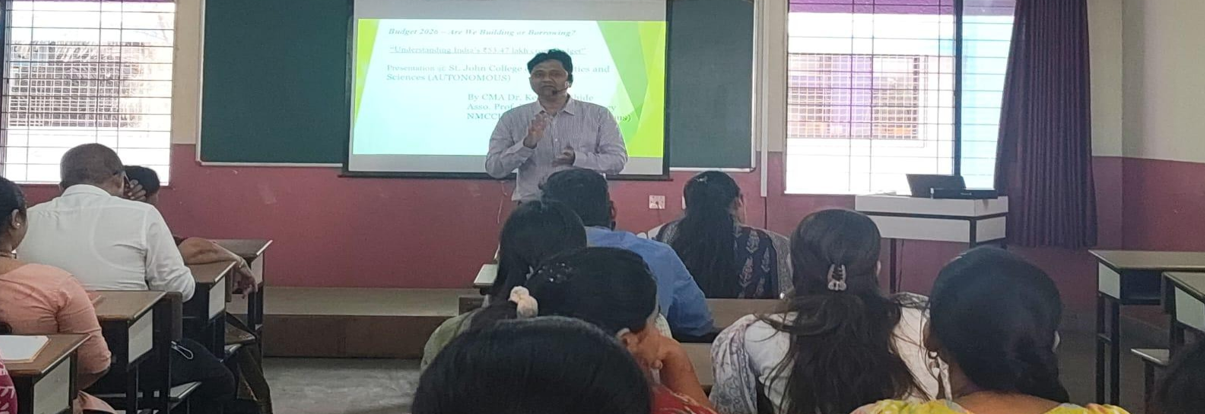
Programme on Union Budget 2026: Policy Analysis and Academic Implications
Organized by: Department of Commerce (Management Studies) in collaboration with IQAC Institution: St. John College of Humanities and Sciences (Autonomous), Palghar
Date: Saturday, 28th February 2026
Time: 11:00 AM – 01:00 PM
Venue: Classroom No. 5, SJCHS
Resource Person: CMA Dr. Kedar V. Bhide, Associate Professor, NM College of Commerce & Economics (Empowered Autonomous), Mumbai
1. Introduction: The Department of Commerce (Management Studies), in collaboration with the Internal Quality Assurance Cell (IQAC), organized an exclusive Faculty Interactive Session on “Union Budget 2026: Policy Analysis and Academic Implications.”
The objective of the session was to enhance faculty understanding of India’s Union Budget 2026, fiscal strategy, and its macroeconomic implications. The session aimed at strengthening faculty competency in delivering updated and research-oriented content in subjects such as Public Finance, Indian Economy,, Taxation, and Fiscal Policy.
2. Objectives of the Session: The session was organized with the following academic objectives:
1. To critically analyze the structure of Union Budget 2026 (₹53.47 lakh crore).
2. To understand the fiscal deficit (4.3%) and borrowing strategy (₹16.96 lakh crore).
3. To evaluate debt sustainability and interest burden (approx. 26% of revenue receipts).
4. To interpret allocation, redistribution, and stabilization functions of fiscal policy.
5. To connect budget provisions with curriculum delivery and research perspectives.
6. To strengthen faculty’s analytical and policy interpretation skills.
3. Key Themes Discussed
A. Overview of Union Budget 2026
Dr. Kedar V. Bhide opened the session with a thought-provoking question:
If India spends ₹53.47 lakh crore and borrows ₹16.96 lakh crore are we building capacity or creating debt pressure?”
Major highlights included:
Total Expenditure: ₹53.47 lakh crore Fiscal Deficit: 4.3% of GDP Borrowings: ₹16.96 lakh crore
Interest Payments: Nearly 26% of total revenue receipts
The discussion emphasized that borrowing for capital formation is productive, but borrowing for revenue expenditure can create long-term fiscal stress.
B. Fiscal Responsibility and FRBM Act, 2003
The session revisited the Fiscal Responsibility and Budget Management (FRBM) Act, 2003 and discussed:
● Importance of fiscal discipline
● Deficit control mechanisms
● Long-term sustainability of public debt
C. Functions of Budget (Conceptual Framework)
Dr. Kedar V. Bhide explained the three core functions of Budget:
1. Allocation Function
Efficient allocation of resources towards infrastructure, defence, education, health, and digital economy.
2. Redistribution Function
Social welfare schemes, rural spending, and targeted subsidies to reduce inequality.
3. Stabilization Function
Maintaining macroeconomic stability by controlling inflation and stimulating growth when required.
This part was highly relevant for faculty teaching Public Finance and Macro Economics.
D. Counter-Cyclical Fiscal Policy (Interactive Discussion) The session included real-life macroeconomic simulations:
1. When Inflation Rises (e.g., 7%)
● Reduce revenue expenditure
● Coordinate with RBI for higher interest rates
● Reduce aggregate demand
2. When Growth Slows (e.g., 5%)
● Increase capital expenditure
● Boost rural income
● Encourage private investment
3. Crowding-In Effect
If private investment falls, increased public capex improves:
● Infrastructure
● Business confidence
● Future profitability
This practical explanation helped faculty link theory to real-time budget strategy.
4. Revenue and Expenditure Structure Analysis The resource person explained:
Revenue Sources:
● Tax Revenue (Direct + Indirect)
● Non-Tax Revenue
● Disinvestment Receipts
● Borrowings
5. Expenditure Classification:
● Revenue Expenditure
● Capital Expenditure
6. The emphasis was on:
● Rising capital expenditure as a growth engine
● Managing revenue deficit
● Balancing welfare and infrastructure spending
7. Outcome of the Session:
The session achieved the following outcomes:
● Improved faculty understanding of fiscal policy tools
● Strengthened analytical approach towards national budget
● Encouraged integration of contemporary policy issues into curriculum
● Promoted research-oriented academic culture
● Supported IQAC quality initiatives under Faculty Development
8. Conclusion: The Faculty Development Session on Union Budget 2026: Policy Analysis and Academic Implications was intellectually enriching and academically impactful.
Dr. Kedar Bhide successfully bridged the gap between macroeconomic theory and practical fiscal realities. The session emphasized that:
“Borrowing is not the problem; unproductive borrowing is the problem.”
The program contributed significantly towards academic excellence, policy literacy, and research culture within the institution.