






Faculty Development Session on the topic NEP 2020 Framework:
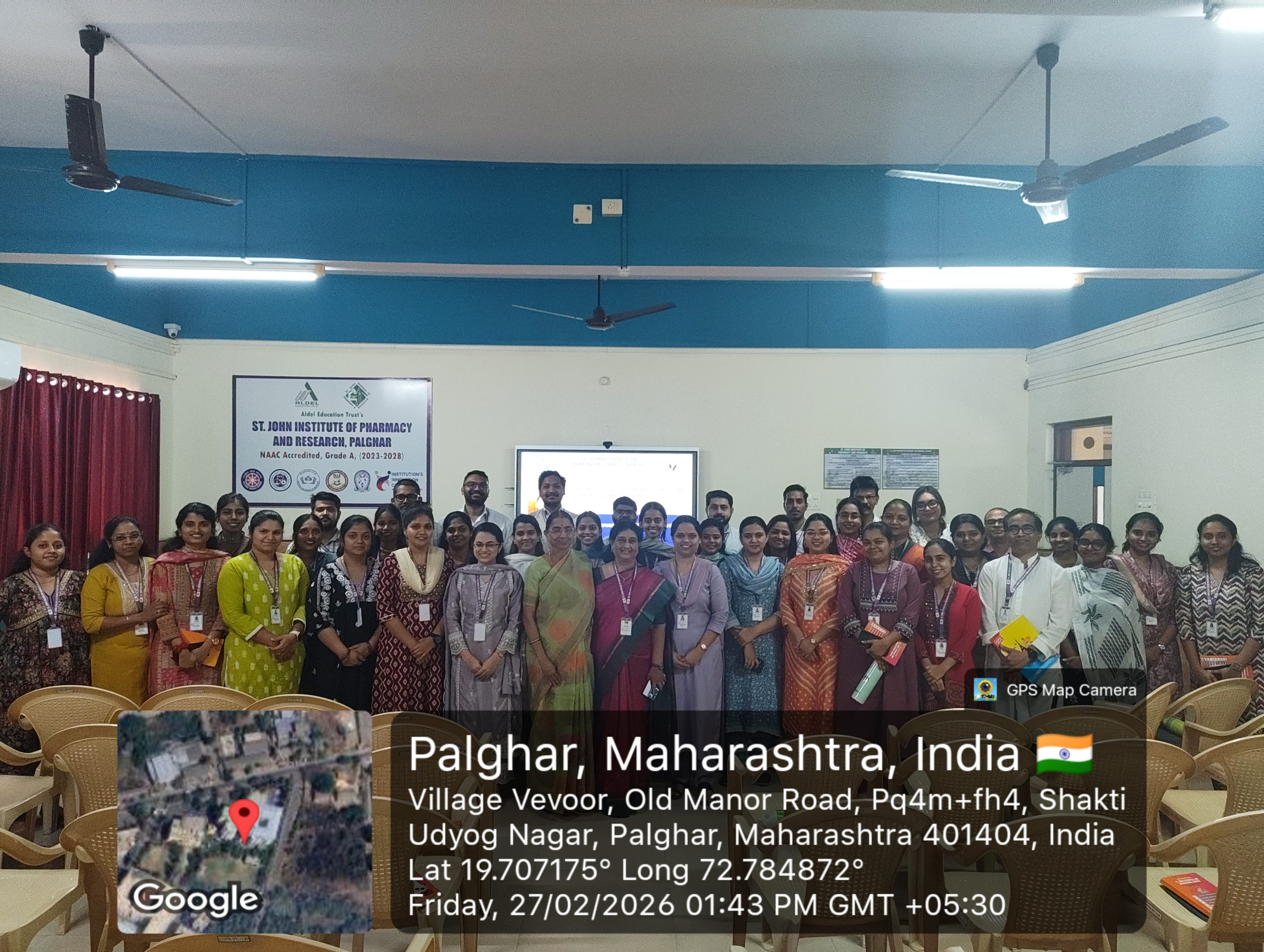
Faculty Development Session on the topic NEP 2020 Framework: Institutional Autonomy and Curriculum Design for Academic Excellence was held on Friday, 27th February 2026 from 11:00 a.m. to 1:00 p.m. at SJIPR Seminar Hall. The Resource Person was Dr. Shobana Vasudevan, Former Principal, R.A. Podar College of Commerce and Economics (Autonomous)
Topic: NEP 2020 Framework: Institutional Autonomy and Curriculum Design for Academic Excellence
Date: Friday, 27th February 2026
Time: 11:00 a.m. to 1:00 p.m.
Venue: Seminar Hall, SJIPR
Resource Person: Dr. Shobana Vasudevan, Former Principal, R.A. Podar College of Commerce and Economics (Autonomous)
Inaugural Proceedings: The session formally began with a solemn recitation of the Universal Peace Prayer. The programme officially commenced with a warm and detailed introduction of the resource person, Dr. Shobana Vasudevan, by Ms. Anshu Tiwari, Head of the BAF Department.
To honor her presence and expertise, the resource person was felicitated by the Principal, Dr. Muktha Manoj Jacob, alongside Dr. Charles Pais (Campus Exam Advisor), Dr. Priya Chaurasiya (IQAC Coordinator), and other representatives from St. John College of Humanities and Sciences.
1. Session Overview & Introduction: The session began with an introduction to the core themes driven by the National Education Policy (NEP) 2020: the crucial interrelationship between NEP 2020, Institutional Autonomy, and achieving Academic Excellence.
Dr. Vasudevan opened the discussion by establishing the fundamental need for reform in education. She emphasized that the primary goal is to ensure education evolves to match the needs of the current-day learner. The session aimed to help participants appreciate the true spirit of the NEP rather than just focusing on implementation mechanics.
Participants were challenged to consider if everyone in the institution is “on the same page” regarding key concepts such as:
● The definition of “Education”
● The role of Autonomy
● Designing Syllabi and Curriculum
● Assessment methods
● Shifting toward Outcome-based education
2. Redefining Academic Excellence: A significant portion of the session was dedicated to deconstructing the concept of academic excellence in the context of the future generation.
Key discussion points included:
● A Broader Definition: Excellence is not restricted solely to marks or grades.
● The “Why” and “How”: The discussion moved beyond defining excellence to exploring why it is necessary and, practically, how an institution can achieve it.
● Graduate Attributes: A critical focus was placed on whether institutions should articulate clear “graduate attributes” (skills and qualities a student should possess upon graduation).
● The Innovation Term: Innovation was highlighted as a frequently discussed but essential component of achieving excellence.
Expected Outcomes for Learners: To achieve true excellence, the session suggested institutions must address several questions regarding their future student output:
● What are the general complaints about current graduates?
● Should the institution list explicit graduate attributes?
● What is the expected outcome from the learners?
● Can the institution do something different to improve these outcomes?
3. Understanding Autonomy: Dr. Vasudevan provided a nuanced perspective on what Institutional Autonomy truly entails, clarifying common misconceptions.
What Autonomy IS:
● It is about Academic Freedom.
● It is a right that comes with significant responsibility.
● It functions as a “double-edged sword,” offering opportunity but requiring careful management.
What Autonomy is NOT: The session clarified that autonomy should not be viewed as:
● A panacea (cure-all) for all institutional ills.
● A “magic wand” that instantly solves problems.
● Primarily a “money spinner” for the institution.
● Wholesale immunity from all problems.
The Intersection of Autonomy and Academic Excellence: The speaker argued that autonomy serves as the necessary vehicle or tool to:
1. Reduce the gap between what the institution currently has and what it wants to achieve.
2. Achieve excellence 360 degrees.
3. Ensure the highest level of inclusivity.
4. Foster stakeholder unity (specifically mentioning parents).
5. Seize the opportunity to rewrite the meaning of Education.
A practical advantage of autonomy highlighted was the flexibility it provides in offering and taking courses.
4. Making Things Easy: NEP 2020 Implementation Strategies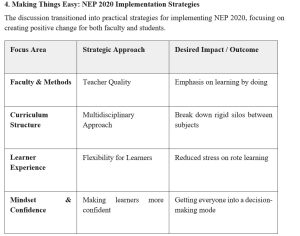
5. Opportunities, Practical Limitations, and Challenges: The session concluded by realistically addressing the external and internal landscapes that influence educational reform.
Visible and Invisible Challenges (External/Systemic):
● The Value Gap: A persistent mismatch between defined Graduate Attributes and real-world expectations.
● External Pressures: High expectations from parents and society.
● Market Realities: The current state of the job and employment market.
● Unemployability: The ongoing issue of graduate unemployability.
● Managerial Strain: A sense of “helplessness” among education managers.
● Disturbances: Psychological and social disturbances affecting students.
● Technological Shift: Managing digital disruptions.
Key Educational Opportunities to Leverage: Despite challenges, NEP and Autonomy offer powerful mechanisms for improvement:
● Encouraging innovation.
● Enhancing academic freedom.
● Creating objective evaluation systems.
● Driving standardization and simplification.
● Underlining transparency.
● Embedding technology deeply into processes.
● Placing renewed stress on Value Education and Indian Knowledge Systems (IKS).
Practical Institutional Limitations: The roadmap to excellence must account for constraints such as:
● Limitations inherent in single-faculty colleges.
● The challenges of mass education.
● Difficulties in student and faculty mobility.
● The disconnect with school-level education.
● Challenges in securing internships and On-the-Job Training (OJT).
● Cost escalation associated with reforms.
6. Conclusion: The session provided a comprehensive roadmap for utilizing institutional autonomy as the primary lever for implementing the spirit of NEP 2020. Dr. Vasudevan emphasized that by redefining academic excellence, focusing on practical learner outcomes, and strategically managing both opportunities and challenges, institutions can successfully navigate the transition toward a more effective and relevant educational framework.
Concluding Remarks & Vote of Thanks: The session concluded with valuable feedback from Ms. Anshu Tiwari, who highly appreciated the energy and passion of Dr. Vasudevan, noting that her vibrancy truly defied her age. The audience remained enthralled throughout by the speaker’s unique blend of wit, wisdom, and her visible commitment to lifelong learning.
The programme ended with a formal Vote of Thanks delivered by Ms. Gazal Asar, who expressed sincere gratitude to:
● The Resource Person for her insightful and spirited session.
● The Principal, Dr. Muktha Manoj Jacob, for her leadership.
● The Faculty Members for their active and engaged participation.