





Policy Shark Tank Programme Held
Policy Shark Tank Programme Held
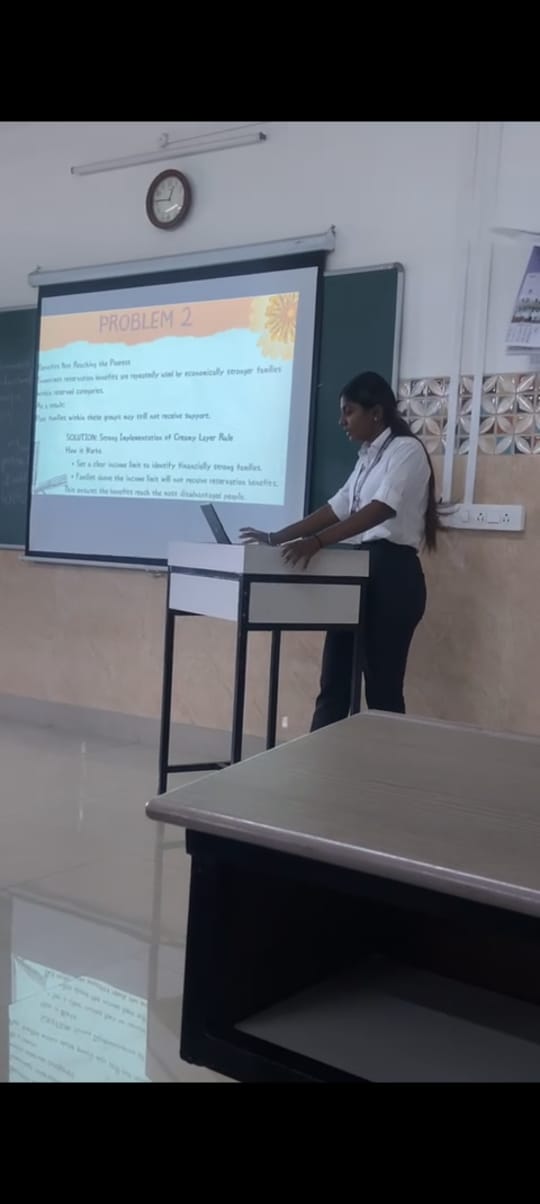
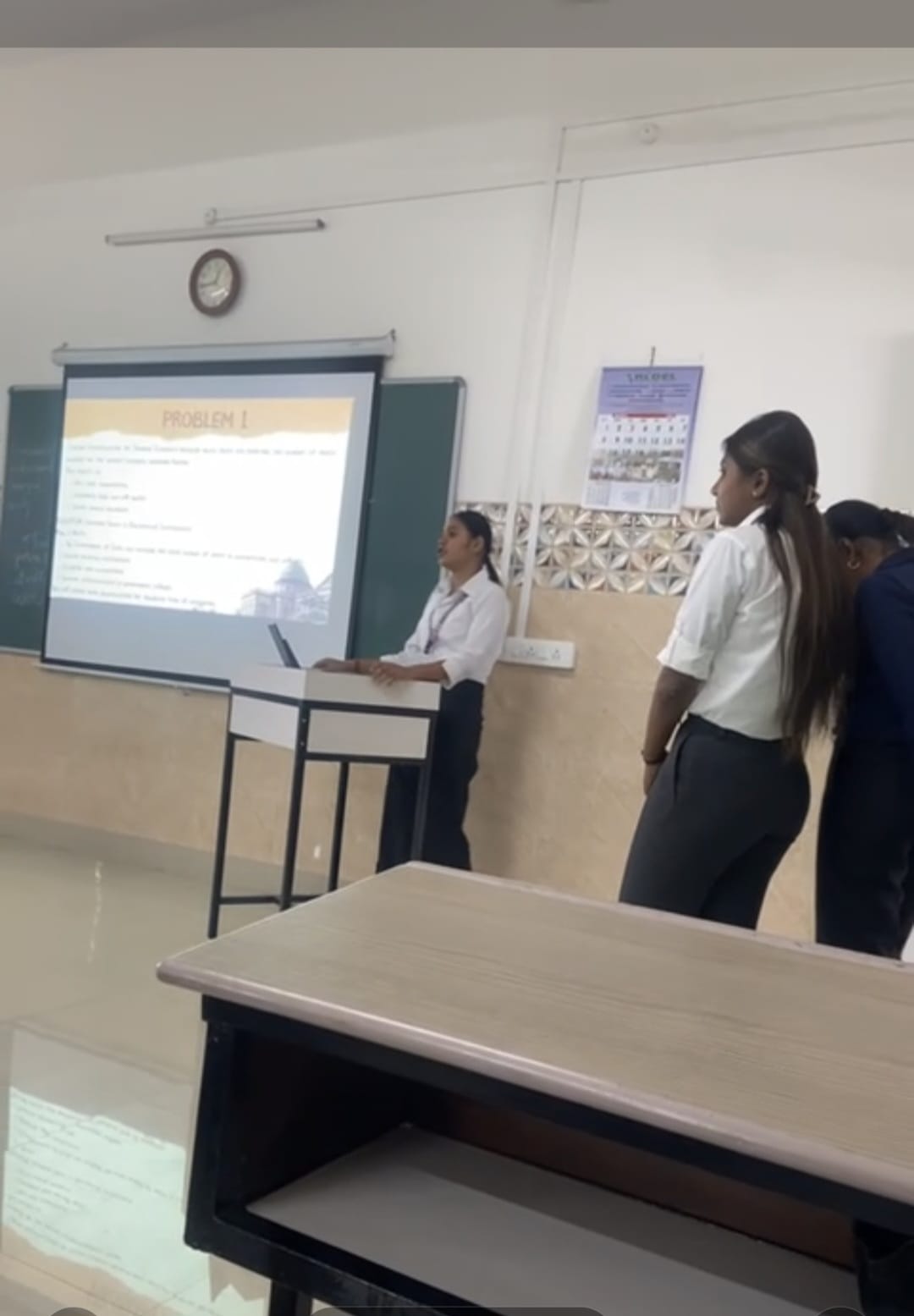
The BA Department held a programme titled “Policy Shark Tank” on 13th March 2026 from 12.30 pm to 2.30pm in Classroom No. 410, Pharmacy Building, Aldel Education Trust. Keerthana Rajeev was the activity in-charge, and 12 students participated in the programme and 24 S.Y. BA students benefited from it.
Date: 13th March 2026 12.30 pm to 2.30pm
Department / Committee: BA
Venue: Classroom no.410, Pharmacy building
No. of Participants: 12
Nature of Activity: Academic Activity
No. of students attended: 24 ( All SYBA)
Mode of Activity: Offline
Name of Activity In charge: Keerthana Rajeev
Activity Information:
Objectives:
● To make students aware of current affairs and national issues.
● To develop students’ ability to formulate solutions and convert them into viable policy proposals.
● To help students understand the functioning of the government and the economy.
● To encourage thinking from the perspective of policymakers and governance.
Target Audience: Second-Year BA Students
Methodology: The activity commenced with a welcome address, followed by an introduction to the “Policy Shark Tank” concept and its objectives. The format was designed to simulate a policy-making pitch environment.
Students, divided into teams, were required to select a current socio-economic issue, conduct preliminary research using government surveys and data, and develop a potential policy solution. Each team was given a set time to present their policy proposal, including the problem statement, proposed solution, implementation strategy, and expected outcomes, to the judge.
The session was judged by Dr. Jaydip Raval, who provided expert feedback on the feasibility, originality, and understanding of economic and governance principles demonstrated in each proposal. The presentations were followed by a brief Q&A round where the audience could ask clarifying questions. The activity concluded with a valedictory session where Dr. Raval shared his insights on the policy-making process and announced the winning team, followed by a vote of thanks.
Outcomes:
● The activity significantly enhanced students’ presentation skills and their ability to articulate complex ideas clearly and concisely.
● · Participants developed crucial problem-solving skills by learning to deconstruct issues and formulate structured, data-backed policy solutions.
● · Students gained a practical understanding of governance by being challenged to think from the perspective of the government, considering implementation challenges and broader economic impacts.
● · Participants learned the importance of data in policy-making, specifically how to identify, interpret, and utilize data from government surveys to support their arguments.
● · The interdisciplinary nature of the activity fostered collaboration and peer learning among students from different backgrounds within the social sciences.
● · Exposure to expert feedback from Dr. Jaydip Raval provided students with valuable real-world insights into the policy-making landscape
SWOT Analysis of the Event:
Strength:
• High level of student interest and engagement in the unique “Shark Tank” format.
• Innovative and practical proposals presented by the participating students, demonstrating creativity.
• Expert judging by Dr. Jaydip Raval added immense value and credibility to the event.
• Successfully linked theoretical knowledge with practical application in governance and economics.
Weakness:
• Participation was limited to BA second-year students, preventing a wider cross-departmental exchange of ideas.
• Time constraints may have limited the depth of Q&A and feedback for each team.
• Uneven participation was noted as some students were more dominant within their teams than others.
Opportunity:
• This activity can be scaled and introduced as a flagship event for the entire department, encouraging participation from all years and specializations.
• Potential to collaborate with political science or economics departments from other colleges for an inter-collegiate version.
• Opportunity to invite policymakers or government officials as judges in future editions to provide even greater exposure.
Threats:
• The complexity of policy-making might discourage some students from participating in the future if not positioned as a learning experience.
• Without institutionalizing it as an annual event, the momentum and interest generated may be lost.
• Superficial analysis of issues if students rely on unverified sources instead of official data.