



Session on “Continuous Internal Assessment under Autonomy


Session on “Continuous Internal Assessment under Autonomy
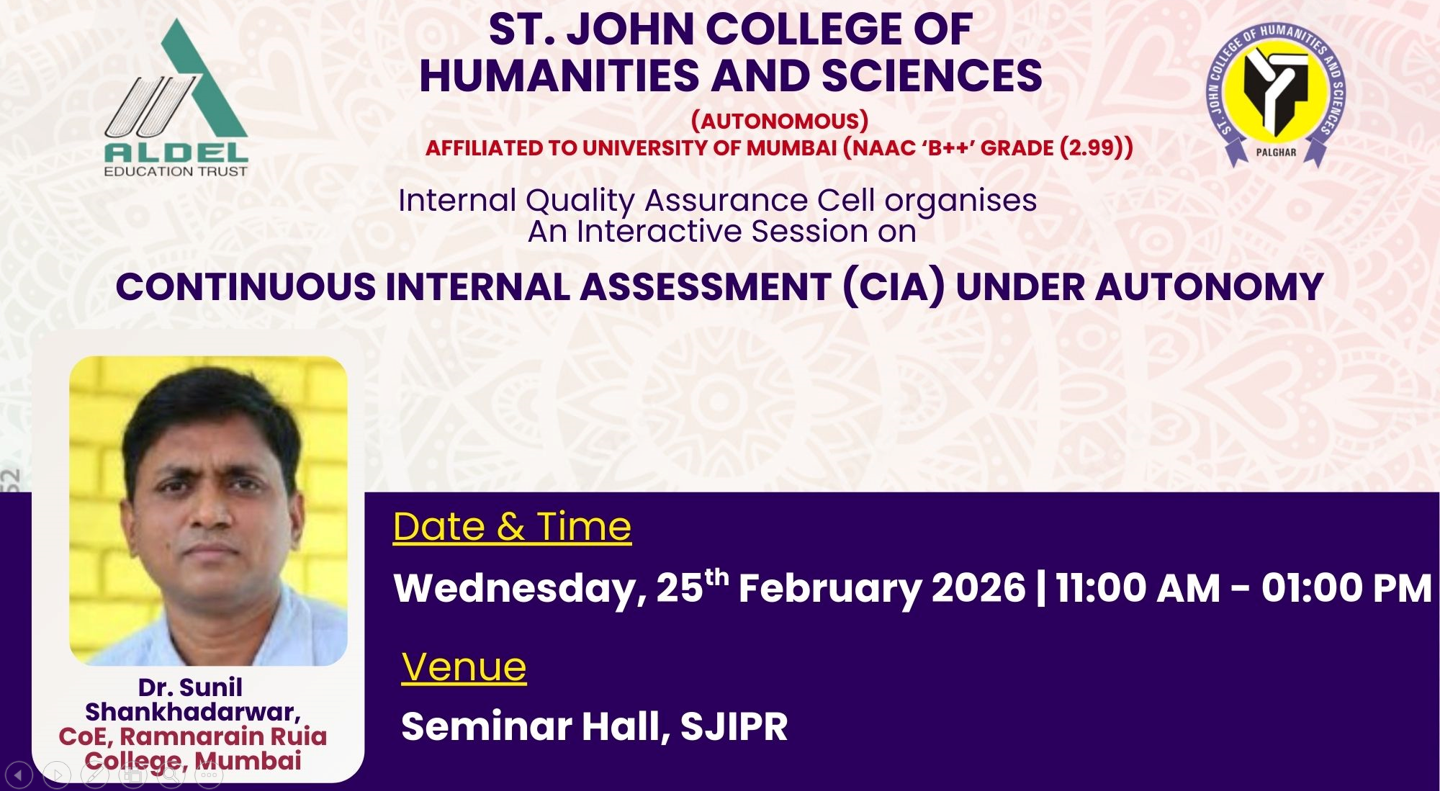
Date: Wednesday, 25th February 2026
Time: 11:00 AM to 01:00 PM
Venue: Seminar Hall, SJIPR
A comprehensive and insightful session on “Continuous Internal Assessment under Autonomy” was conducted by Dr. Sunil Shankhadarwar, Controller of Examinations, Ramnarain Ruia Autonomous College. The session was organized for the faculty members of St. John College of Humanities and Sciences to deliberate upon effective examination reforms in light of autonomy and the National Education Policy.
Introduction and Opening: The programme commenced with a warm introduction of the resource person by Dr. Akanksha Thakur, who highlighted Dr. Shankhadarwar’s extensive experience in examination reforms and autonomous academic practices. The session formally began with the recitation of the Universal Peace Prayer, setting a reflective and academic tone for the deliberations.
Felicitation of the Resource Person: The resource person was felicitated by the Principal, Dr. Muktha Manjoj Jacob, along with Dr. Charles Pais, Campus Exam Advisor, and Sachin Gawali, Controller of Examinations, St. John College of Humanities and Sciences. The felicitation acknowledged Dr. Shankhadarwar’s contribution to strengthening examination systems under autonomy.
Key Deliberations on Continuous Internal Assessment: Dr. Shankhadarwar presented an in-depth overview of Continuous Internal Assessment (CIA) and emphasized its growing significance under the National Education Policy. He noted that most autonomous colleges are presently adopting the 60:40 examination pattern, wherein:
● 60% weightage is allotted to the External (Semester-End) Examination
● 40% weightage is allotted to Internal Assessment
He elaborated that the Internal component generally comprises:
1. Class Tests – To periodically assess conceptual understanding
2. Assignments/Projects – To evaluate analytical and research skills
3. Attendance and Participation – To ensure academic discipline and engagement
4. Viva Voce – To assess oral articulation and conceptual clarity
Regarding the passing criteria, he explained that students must secure a minimum of 40% marks, either:
● Combined in both internal and external components, or
● Independently in both components
He emphasized that autonomous colleges have the discretion to decide the applicable criterion. The fundamental objective, he stated, is to ensure balanced competence across knowledge, skills, participation, and application.
Illustrative Internal Examination Schemes:
Dr. Shankhadarwar further explained three commonly adopted internal evaluation schemes:
Scheme 1:
● Class Test – 20 Marks
● Assignment – 10 Marks
● Attendance – 10 Marks
Scheme 2:
● Test 1 – 20 Marks
● Test 2 – 20 Marks
Scheme 3:
● Class Test – 15 Marks
● Assignment – 15 Marks
● Attendance – 10 Marks
He mentioned that Scheme 2 is the simplest and most widely adopted model among autonomous colleges due to its ease of administration and transparency.
Components of Continuous Internal Evaluation (CIE)
He then elaborated on a more structured Continuous Internal Evaluation model, which may include:
● Weekly Quizzes – 10 Marks
● Mid-Semester Test – 15 Marks
● Assignments – 10 Marks
● Attendance and Class Interaction – 5 Marks
Additionally, he encouraged innovation in assessment practices, especially under autonomy. Suggested innovative components included:
● Group Discussions
● Field Visit Reports
● Listening Skills Examination (particularly for AEC courses)
● Online Examination Platforms developed in collaboration with the IT Department
Conduct and Administration of Internal Examinations
Dr. Shankhadarwar explained that class tests may either:
● Be conducted centrally by the Examination Cell, or
● Be conducted by individual class teachers
In the latter case, teachers must collect question papers and answer scripts from the Examination Cell and return evaluated scripts thereafter. The Examination Cell must maintain proper records of marksheets and evaluated copies to ensure transparency and accountability.
Additional Examinations and Attendance Norms: He strongly advised against allowing students to take undue advantage of additional internal examinations, except in genuine cases. Colleges may formulate clear conditions—for instance, permitting additional exams only to students with above 75% attendance.
For practical examinations, no additional internal assessments should be conducted, except in cases related to NSS and Sports activities.
Moderation and Evaluation Standards: A significant emphasis was placed on external moderation, particularly for Third Year evaluations. He further advised moderation for First and Second Year papers as well, to ensure uniformity and fairness in assessment standards.
Record Maintenance: He recommended maintaining records of assignments, test scores, and assessment documents in soft copy format for efficient documentation and audit compliance.
Presentation by BoS Chairpersons and Discussion: Subsequently, the Chairpersons of the various Boards of Studies (BoS) presented their respective Continuous Internal Examination Schemes for different programmes. A constructive and engaging discussion followed. It was collectively observed that, as an autonomous institution, the College has the flexibility to adopt innovative and discipline-specific assessment strategies that best evaluate students’ competence and holistic development.
Conclusion: The session concluded with valuable feedback from Sachin Gawali, who appreciated the clarity and practical orientation of the session. The programme ended with a formal Vote of Thanks delivered by Namrata Jha, expressing gratitude to the resource person, the Principal, and all faculty members for their active participation.
The session proved to be highly enriching and provided clear direction for strengthening the Continuous Internal Assessment framework under autonomy, aligning institutional practices with contemporary educational reforms.
Session on “Continuous Internal Assessment under Autonomy